Two of the easiest "wow" moments in stargazing share almost nothing in common except that both reward you for looking up at the right time. One is a machine the size of a football field, circling a few hundred kilometers overhead and entirely predictable. The other is a mountain of ancient ice that may not return for thousands of years and shows up largely on its own schedule.
The International Space Station and a bright comet are both naked-eye targets, no telescope required, and both feel a little like catching the universe in motion. The trick with each is knowing when and where to look. This guide covers how to predict an ISS pass to the minute, how to catch a comet when one graces our sky, and what that glowing tail is actually made of.
Spotting the Space Station#
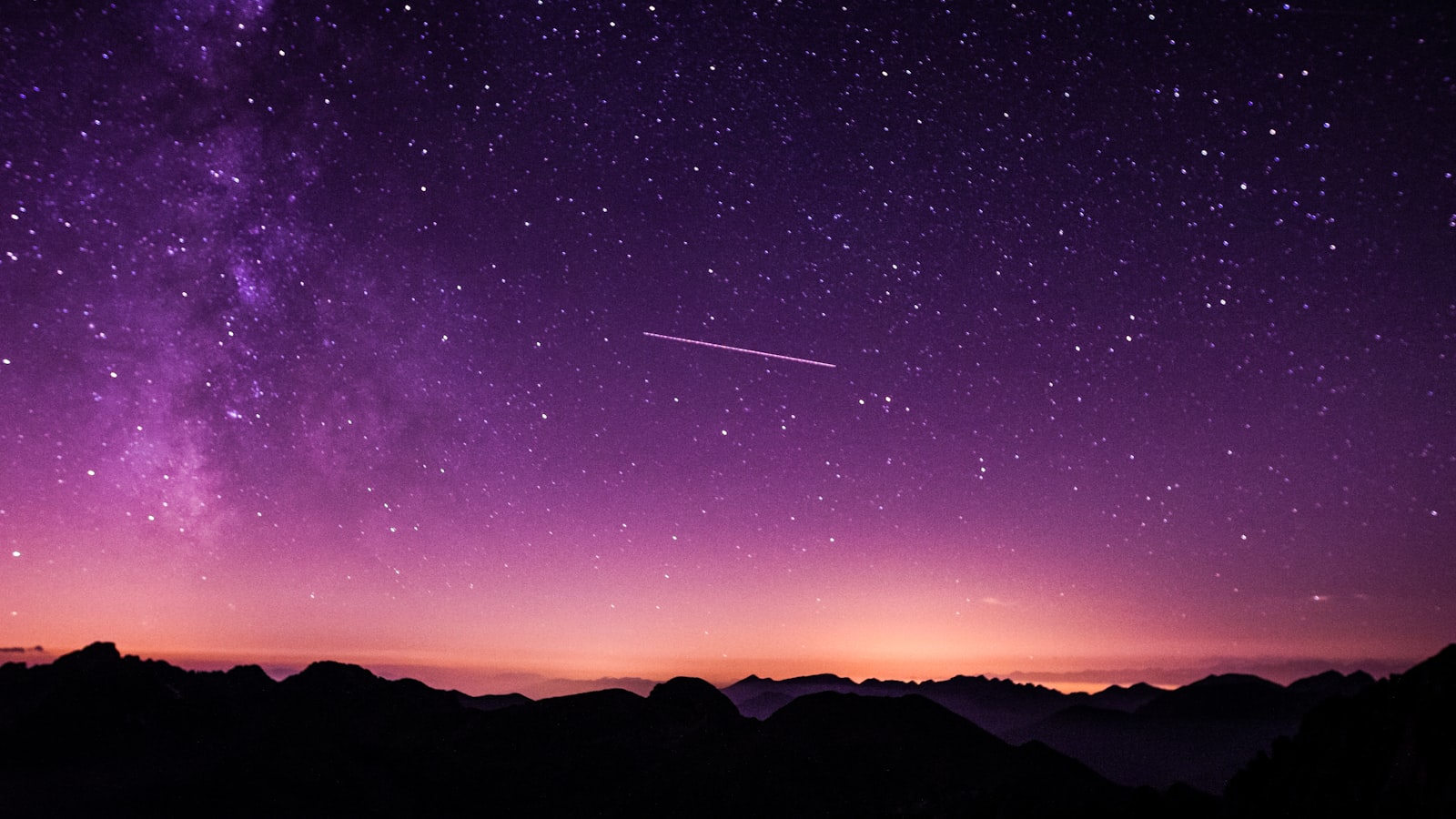
The ISS is the easiest human-made object to see in the night sky, and once you have caught one pass, you will want more. It looks like a brilliant, steady star sliding silently across the sky, brighter than anything around it. It does not blink like an aircraft, and it does not flash; it simply glides, often crossing from one horizon toward the other in a couple of minutes before fading out.
That fade is the giveaway that you are watching a satellite and not a plane. The station shines only because it reflects sunlight, so when it slips into Earth's shadow, it does not set, it just vanishes mid-sky. The best passes come in the hour or two after sunset or before sunrise, when the sky around you is dark but the station, high above, is still bathed in sunlight.
What makes the ISS so satisfying is that it is fully predictable. You can know, days ahead, exactly when it will appear and which way it will travel over your town.
- Use a pass predictor. Free tools and apps will list upcoming passes for your exact location, with start time, direction, and how high it climbs.
- Note the maximum elevation. A pass that climbs high overhead is far brighter and easier than one that skims the horizon.
- Face the right direction at the start time. Predictions tell you where it will rise into view, so you are looking the moment it appears.
- Be out a couple of minutes early. The station arrives on schedule and does not wait.
Watching the ISS cross the sky changes how the night feels. That moving point of light carries people, right now, looping the planet roughly every hour and a half. Few sights make the scale of space feel so immediate.
If you are still building your sense of where things are overhead, pairing pass predictions with a good app makes it almost foolproof; our roundup of the best stargazing apps for beginners points to tools that handle satellite passes well.
Hunting for Comets#
Comets are the wild cards of the sky. Most are far too faint to notice, visible only as smudges through a telescope, and they come and go without fanfare. But every so often a comet brightens enough to be seen with the unaided eye, and when that happens it can hang in the sky for days or weeks, a soft glow with a tail trailing off into the dark.
You cannot schedule a great comet the way you schedule an ISS pass. The bright ones arrive unpredictably, sometimes discovered only months before they reach their peak. What you can do is stay informed, because when a promising comet is inbound, astronomy news and apps will spread the word, along with where and when to look. Comets are usually best near dawn or dusk, low toward the horizon and not far from the Sun's position, which is also why you should never sweep that direction with binoculars while the Sun is up.
When a comet does grace the sky, a few habits help:
- Find a site with a clear, low horizon in the direction the comet is reported.
- Look during deep twilight, when the sky is dark but the comet sits above the horizon haze.
- Bring binoculars, which reveal far more of the tail and the bright head than the naked eye alone.
- Be patient and use averted vision, glancing slightly to one side, to catch the faint outer tail.
Even a modest comet is a thrill, because you are looking at a visitor from the cold outer reaches of the solar system, briefly lit up on its swing past the Sun.
What a Comet's Tail Really Is#
A comet is often described as a dirty snowball, and that is not a bad summary. It is a small body of ice, dust, and rock that spends most of its existence in the frozen distance, far from the Sun. For ages, nothing happens. Then its orbit carries it inward, the Sun's warmth takes hold, and the show begins.
As the comet heats up, its ices turn straight from solid to gas, releasing dust trapped within them. This forms a fuzzy glowing cloud around the solid core, called the coma, and from that cloud the tail streams out. Here is the detail that surprises people: a comet's tail does not trail behind it like smoke behind a train. It points away from the Sun, no matter which way the comet is traveling.
That happens because two forces from the Sun push the released material outward. Sunlight itself nudges the dust into a gently curved tail, while a stream of particles from the Sun, the solar wind, blows the gas into a straighter tail that often glows a faint blue. So a comet heading away from the Sun can actually appear to travel tail-first, with its tail leading the way. The tail is not a wake; it is a flag blown by the Sun's wind.
This is also why comets are temporary spectacles. Each pass near the Sun strips away more material, and over many orbits a comet slowly exhausts itself. The bright one you catch this decade is a little smaller than it was the last time, and a little smaller than it will ever be again.
Catching the Sky in Motion#
What links these two targets is the feeling of motion, of seeing the sky as a moving system rather than a fixed backdrop. The ISS slides over in minutes and proves the heavens are full of traffic. A comet drifts night to night against the stars and proves the solar system is still delivering surprises. Neither asks for a telescope, and both reward a watcher who simply knows when to step outside.
So bookmark a pass predictor and catch the station this week, it is the easy win you can plan tonight. Then keep half an eye on astronomy news, so when the next bright comet comes calling, you are ready to find a clear horizon, look toward the twilight, and meet a traveler that has been falling toward the Sun for longer than humans have existed.