A meteor shower is the rare astronomical event where buying gear actually works against you. Point a telescope at the sky and you have traded a sweeping view for a keyhole, and meteors do not politely arrive inside keyholes. The whole spectacle is built for the naked eye, the broadest, fastest instrument you own.
That makes meteor watching one of the most welcoming things you can do under the stars. There is no setup, no focusing, no star charts to wrestle with in the dark. You lie back, you let your eyes settle, and you wait for the sky to do the work. What follows is how showers happen, which ones are worth losing sleep over, and the handful of choices that turn a slow night into a memorable one.
What You Are Actually Seeing#
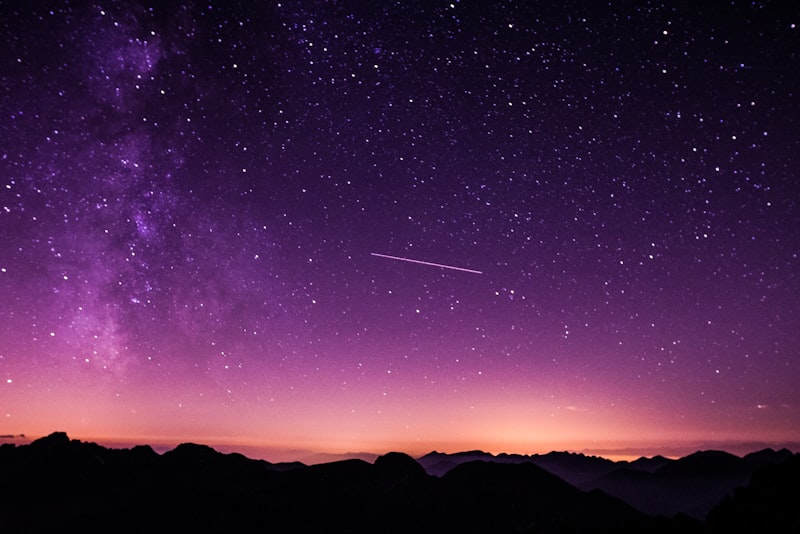
A meteor is not a star, and it is not falling from space in any dramatic sense. It is a speck of debris, often no larger than a grain of sand, slamming into the upper atmosphere at enormous speed. The friction heats the air around it until it glows, and that brief, brilliant streak is what you see. The particle itself usually burns up entirely, far above the ground.
A meteor shower happens when Earth, on its yearly orbit, plows through a trail of debris left behind by a comet, or occasionally an asteroid. Comets shed dust and grit every time they swing near the Sun, and that material spreads out along the comet's path like crumbs. When our planet crosses the trail at the same point each year, we get the same shower on roughly the same dates, year after year.
That is why showers are reliable. The Perseids of August, the Geminids of December, the Quadrantids of early January, the Orionids of October, the Lyrids of April, each one is Earth meeting a familiar stream of debris on schedule. Some streams are dense and produce a generous display; others are thin and offer only a handful of streaks per hour.
The Radiant, and Why You Should Ignore It a Little#
Every shower has a radiant, the point in the sky from which the meteors appear to spread outward. Showers are named for the constellation that contains this point: the Perseids radiate from Perseus, the Geminids from Gemini, and so on. This happens for the same reason snow seems to rush toward a moving car's windshield from a single point ahead, an effect of perspective as Earth moves into the debris stream.
Here is the part that trips people up. You do not stare at the radiant. Meteors near the radiant appear short and foreshortened, while the long, dramatic streaks tend to appear well away from it. The radiant is useful for knowing roughly which part of the sky to favor, and for confirming that a streak belongs to the shower, but your gaze should be wide and relaxed.
- Look up and out. Aim your attention partway up the sky, away from the horizon's haze but not locked onto any one spot.
- Take in as much sky as you can. A reclining position gives you the widest natural field of view.
- Let meteors come to your peripheral vision. Many appear at the edge of your sight before you turn to them.
- Stay loose. Tense, narrow staring tires your eyes and helps nothing.
The biggest mistake new meteor watchers make is treating it like target practice. You are not hunting a single point. You are bathing in the whole dome of the sky and trusting that the streaks will find you.
Stack the Odds in Your Favor#
A meteor shower's quality depends far more on conditions than on the shower's reputation. A modest shower under a truly dark sky can outshine a famous one washed out by light, so where and when you watch matters enormously.
The first enemy is the Moon. A bright Moon floods the sky and erases all but the brightest meteors, so the best nights pair a strong shower with a Moon that is new or below the horizon. Check the lunar phase before you commit; understanding the lunar phases helps you predict whether the Moon will be a problem on any given night.
The second enemy is light pollution. City skies hide the faint meteors that make up most of any shower. You do not need a remote mountaintop, but driving even a short way out of town can multiply how many streaks you see. If you want to gauge your local sky before heading out, the Bortle scale is a practical way to size up your conditions.
Timing matters too. Most showers improve after midnight, because in the pre-dawn hours your part of the planet is turned into the direction of Earth's motion, scooping up debris head-on. The hours before sunrise are often the richest, which is exactly why meteor watching rewards people who are willing to set an alarm.
A Simple Plan for the Night#
You need almost nothing, but a little preparation turns a cold, frustrating vigil into a comfortable one. The goal is to stay warm, stay relaxed, and protect your night vision so your eyes catch the faintest streaks.
- Pick a shower near its predicted peak, and confirm the Moon will not spoil it.
- Choose a dark, open site with a clear view of as much sky as possible.
- Bring a reclining chair or a ground pad, plus far more warm layers than you think you need.
- Arrive early and give your eyes a full twenty to thirty minutes to adapt to the dark.
- Keep phones away, or switch to a dim red screen so you do not undo your dark adaptation.
That last point is worth taking seriously. A single glance at a bright phone resets your night vision and costs you faint meteors for several minutes. Many regular observers keep a red flashlight handy and learn early how to protect their night vision so they get the most from every hour outside.
Then settle in and let go of expectations. Showers come in bursts and lulls. You might see nothing for ten minutes and then three streaks in a row. Bring patience, bring a friend, bring a thermos. The waiting is part of it.
Let the Sky Surprise You#
There is something deeply satisfying about an event that asks for so little and gives so much. No purchase, no manual, no technique to master beyond lying still and looking up. A meteor shower strips astronomy back to its oldest form, the human eye against the open night.
So the next time a shower is forecast, check the Moon, find some dark sky, and dress like you mean it. Lie back, let your eyes adjust, and wait. The first streak always feels like luck. By the third or fourth, you realize the sky has simply been waiting for you to slow down and watch.