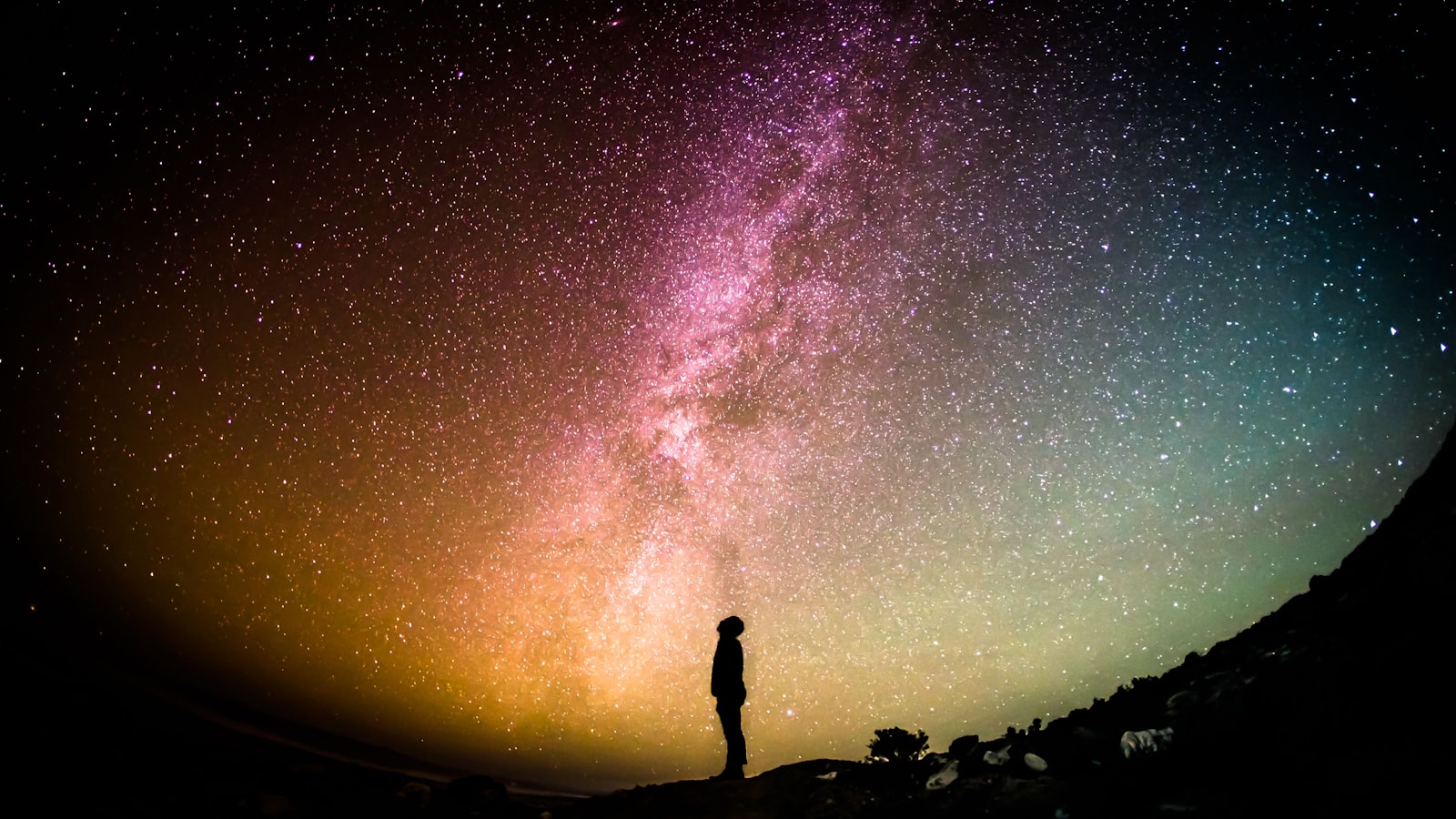
People often assume stargazing begins with a purchase. A telescope, maybe, or at least a pair of binoculars and a stack of guides. The truth is gentler than that. The sky has been free and visible to everyone for as long as humans have had eyes, and your first real nights of looking up cost nothing but a little patience and a willingness to step outside.
I started under a suburban sky with too many streetlights and a neighbor whose porch lamp never turned off. It was not ideal, and it was still wonderful. This guide is for that first stretch of nights, before you decide whether you want any gear at all. We will cover how to prepare your eyes, what to find first, and the small habits that turn a confusing scatter of dots into a sky you can read.
Let Your Eyes Do the Work#
Your eyes are remarkable low-light instruments, but they need time to switch into night mode. When you walk out of a bright room, your pupils are small and your vision is tuned for daylight. Over the next several minutes they widen, and a slower chemical process inside the retina ramps up your sensitivity to faint light. Full dark adaptation usually takes around twenty to thirty minutes, and it keeps improving gently after that.
The catch is that a single glance at a phone screen can undo much of it in an instant. White light is the enemy of night vision. If you need light to find a chair or check a chart, use a dim red source instead, which preserves your adaptation far better. I keep a small red flashlight clipped to my jacket, and if you want to understand why red works so well, it is worth reading more about how to protect your night vision before your first proper session.
A few simple rules make a big difference:
- Step outside and resist the urge to "see something" right away. Let your eyes settle.
- Turn off or cover nearby white lights, including the one over your front door.
- Keep your phone in your pocket, or switch it to a red night mode and dim it fully.
- Look slightly to the side of faint objects rather than straight at them. Your peripheral vision is more sensitive in the dark.
That last trick, called averted vision, feels strange at first. A dim star that vanishes when you stare directly at it will pop back into view when you glance just off to one side.
Start With the Brightest Anchors#
A sky full of stars can feel overwhelming because every point looks the same. The way through is to stop trying to see everything and instead learn a few bright, reliable patterns that act as anchors. From there, the rest of the sky organizes itself around them.
In the northern sky, the Big Dipper is the friendliest place to begin. It is large, distinctive, and visible for much of the year. Once you find it, you can use its two end stars to point your way to Polaris, the North Star, which marks true north and barely moves all night. That single skill unlocks a great deal, and there is a whole approach built around it that you can explore in our guide to finding constellations using pointer stars.
If you are in the evening of a winter night, Orion is the other great anchor. Three bright stars in a short, straight row form his belt, and they are almost impossible to mistake for anything else. Hang on to Orion and the Big Dipper, and you have two fixed reference points to build outward from.
The goal of a first night is not to identify a hundred stars. It is to walk back inside able to find two or three patterns again tomorrow. Recognition, not coverage, is what makes the sky feel like home.
What You Can Actually See#
Naked-eye observing is sometimes treated as a lesser version of "real" astronomy. It is not. Plenty of the sky's best sights need no magnification at all.
On a clear, reasonably dark night you can watch the Moon shift its phase and position from evening to evening. You can pick out the brighter planets, which shine with a steady light rather than the gentle twinkle of stars. Venus can be dazzling near sunrise or sunset, and Jupiter and Mars are easy to spot when they are well placed. You can trace the slow turning of the whole sky over a couple of hours as Earth rotates beneath it.
If your sky is dark enough, the faint band of the Milky Way arches overhead, a hazy ribbon that is the combined glow of countless distant stars. Whether you can see it depends a great deal on light pollution, and learning to gauge your local conditions using the Bortle scale will tell you a lot about what to expect on any given night.
Build a Few Quiet Habits#
The difference between a frustrating night and a satisfying one usually comes down to comfort and rhythm rather than equipment. Cold, stiff necks and impatience send more beginners back indoors than bad skies do.
Dress warmer than you think you need to. Standing still under an open sky drains heat quickly, even in mild weather, and you will stay out longer if you are cozy. A reclining chair or a blanket on the ground saves your neck from the strain of craning upward for an hour. A warm drink helps. So does choosing a night when you are not exhausted, because tired eyes and a tired mind make poor observers.
Try these starting habits:
- Pick a regular spot you can return to, so the sky becomes familiar in the same frame.
- Note one new thing each session rather than chasing dozens.
- Keep a small notebook, or use your phone's voice memo, to record what you found.
- Go out across the month and watch how the same constellations rise earlier each week.
That last point is one of the quiet pleasures of this hobby. The sky is not static. The same stars return a little earlier each night, and over a season the whole cast of characters rotates, which is the beating heart of learning the sky by season.
Where Your First Nights Lead#
The honest reward of naked-eye stargazing is that it never expires. Years from now, even with a telescope set up beside you, you will still look up first with your own eyes to get your bearings. The patterns you learn this month become the map you use forever.
So go outside tonight if the sky is clear. Give your eyes their twenty quiet minutes. Find the Big Dipper, trace your way to Polaris, and let that be enough. Tomorrow, find them again. The sky rewards the people who keep coming back, and the only tool you truly need is the one you already have.